About Lead
Lead is a soft and malleable metal with a relatively low melting point. These properties make it easy to work and cast, and in combination with the relative ease of extracting lead metal from its ore, are responsible for its early use by human societies. The earliest lead artifacts, found in modern-day Turkey, date back to 6400 BCE. Lead was used most extensively in antiquity by Roman society, who produced the metal on an industrial scale as a byproduct of silver smelting and used it in the production of pipes to carry water. The metal was known to the Romans by the latin plumbum, from which both the element’s symbol on the periodic table and the English word “plumbing” are derived. The English “lead” is known to have Anglo Saxon roots, but there are conflicting accounts of its precise etymology.
Even ancient civilizations had some awareness of the toxicity of lead, as several Greek and Roman scholars noted stomach pains, paralysis, and other ailments in workers who dealt frequently with the metal. Despite this, lead was used in pipes, dishes, cosmetics, coins, and paints, and even intentionally added to foods in the form of lead acetate. Over time, further evidence of the element’s toxicity accumulated, but the severity of the risk still failed to be fully appreciated or adequately mitigated. After the fall of Roman civilization, lead continued to be used in pipes and artist pigments, and lead oxide was used to make leaded glass or lead crystal. Lead glass containers were often used to store alcoholic beverages for long periods, allowing lead to leach into the liquid. Lead was also a major component of type metal, the alloy used to produce the moveable type used in printing presses.
Lead compounds ubiquitous well into the twentieth century: lead pigments were commonly found in artists paints and house paint, tetraethyllead was used as an antiknock agent in automotive fuel, and lead solder was used to seal joints between pieces of pipe used to carry drinking water until new regulations were effected starting in the 1970s. The effects of these applications linger even today--leaded fuel is still sold in developing nations and for some types of aircraft, and lead in plumbing and paint in older buildings is still often causes neurotoxicity in children, who are particularly susceptible to lead's health effects.
Today, lead continues to be used, though primarily in applications where the health and environmental risks are low, or where no suitable alternatives have yet been presented. More than half of all lead produced annually is used in lead-acid car batteries. Though using such toxic batteries is not ideal, alternatives are being researched and the majority of lead-acid batteries are recycled, keeping the majority of their lead content out of the waste stream. Lead is often used to line walls or storage containers to provide radiation shielding, and in weights used in sports equipment and applications such as scuba diving and boat ballast, all applications that present relatively low environmental risk. Lead oxide is still used to produce high-refractive index glass and to produce glass solder. These glasses are mostly used for optical applications or in electronics, and therefore the concern of lead leaching into liquids meant for consumption is not significant. Finally, lead-containing soft solder is being phased out of use in electronics due to concerns about leaching following the disposal of the devices.
One final use of lead is in semiconductor devices. There are four binary lead semiconductors: lead iodide, lead sulfide, lead selenide, and lead telluride. Each of these is used in producing radiation detectors--lead iodide in detectors of high-energy radiation such as x-rays or gamma rays, and the remaining three in infrared detectors. Additionally, nanocrystals or “quantum dots” of these compounds, in addition to ternary lead semiconductors, are areas of active research. There is potential for lead-containing quantum dots to be used in solar cells or advanced display screens in the future.
The most commonly exploited lead mineral is galena, a naturally occurring form of lead sulfide. Lead ores are roasted to produce lead oxides, which are then reduced to metallic lead. Only about half of lead used annually comes from newly mined ores; the rest is acquired through recycling.
Products
Large quantities of lead, both the dioxide and the metal, are used in batteries, cable covering, plumbing, and ammunition. Lead is highly resistant to corrosion and can be used to contain corrosive liquids such as sulphuric acid. Lead is also extremely effective at absorbing sound and vibration. It is used as radiation shielding for X-ray equipment and nuclear reactors. Lead  alloys include solder, type metal, and various anti-friction metals and compounds. Lead oxides are used in producing fine "crystal glass" and "flint glass" of a high index of refraction for achromatic lenses. Lead ceramics and crystalline material have a wide range of industrial and optical applications, including infrared detection and imaging. Lead-based semiconductors, such as lead telluride, lead selenide and lead antimonide are finding application in photovoltaic (solar energy) cells and infrared detectors. White lead, the b
 asic carbonate, sublimed white lead, chrome yellow, and other lead compounds are used in paints- although the use of lead in paints has been drastically curtailed in recent years to reduce health hazards. Lead is available as metal and compounds with purities from 99% to 99.9999% (ACS grade to ultra-high purity). Lead oxides are available in forms including powders and dense pellets for such uses as optical coating and thin film applications. Oxides tend to be insoluble. Lead fluorides are another insoluble form for uses in which oxygen is undesirable such as metallurgy, chemical and physical vapor deposition and in some optical coatings. Lead is also available in soluble forms including chlorides, nitrates and acetates. These compounds are manufactured as solutions at specified stoichiometries.
Lead Properties
 Lead is a Block P, Group 14, Period 6 element.
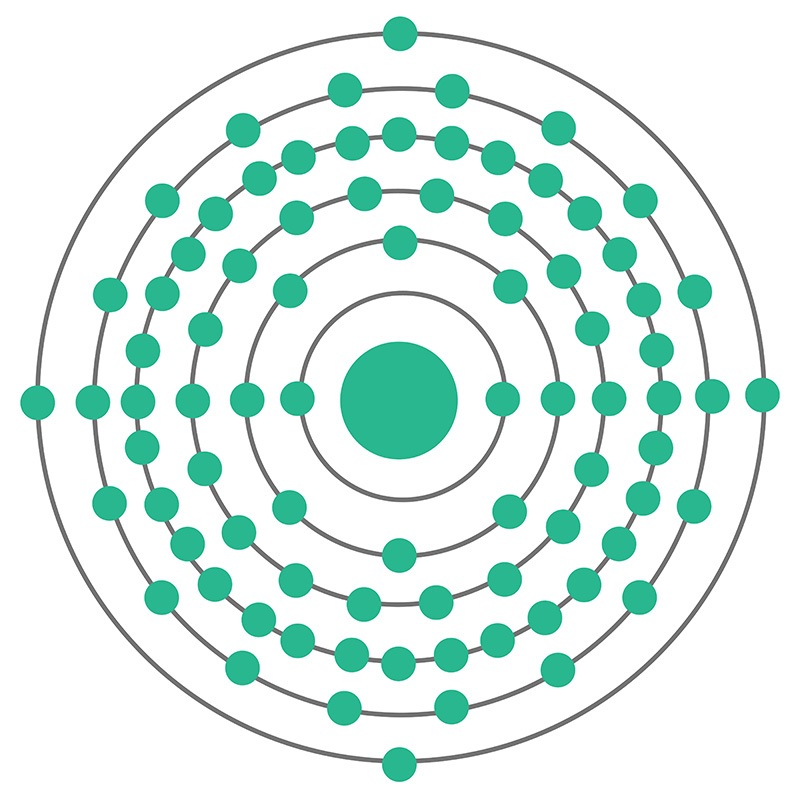
 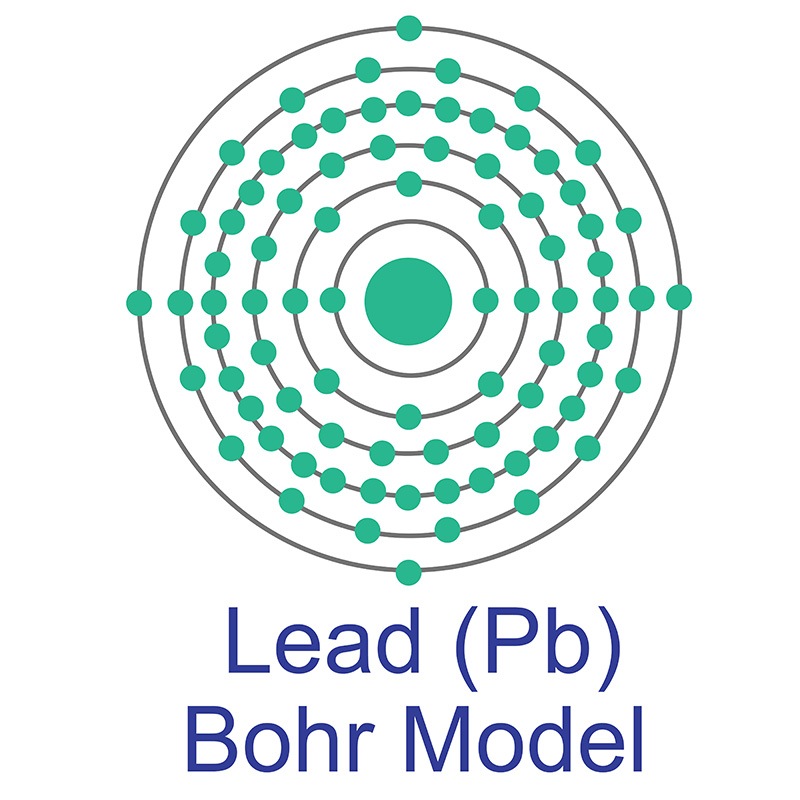 The number of electrons in each of Lead's shells is 2, 8, 18, 32, 18, 4 and its electron configuration is [Xe] 4f14 5d10 6s2 6p2. The lead atom has a radius of 175.pm and its Van der Waals radius is 202.pm. In its elemental form, CAS 7439-92-1, lead has a metallic gray appearance. Lead occurs naturally as a mixture of four stable isotopes: 204Pb (1.48%), 206Pb (23.6%), 207Pb (22.6%), and 208Pb
  (52.3%). Lead is obtained mainly from galena (PbS) by a roasting process. Anglesite, cerussite, and minim are other common lead minerals. Lead has been used by human civilizations for all of recorded history. Lead information, including technical data, safety data, high purity properties, research, applications and other useful facts are discussed below. Scientific facts such as the atomic structure, ionization energy, abundance on earth, conductivity and thermal properties are also included.
Health, Safety & Transportation Information for Lead
Safety data for Lead metal forms, lead nanoparticles and lead compounds. For potential hazard information, toxicity, and road, sea and air transportation limitations, such as DOT Hazard Class, DOT Number, EU Number, NFPA Health rating and RTECS Class, please see the specific lead material or compound referenced in the Products tab. The below information applies to elemental (metallic) Lead.
| Safety Data | |
|---|---|
| Signal Word | Danger |
| Hazard Statements | H302-H332-H360Df-H373-H410 |
| Hazard Codes | T, N |
| Risk Codes | 61-33-40-48/20-51/53-62 |
| Safety Precautions | 53-36/37-45 |
| RTECS Number | OF7525000 |
| Transport Information | N 3077 9/PG 3 |
| WGK Germany | nwg |
| Globally Harmonized System of Classification and Labelling (GHS) |


 |
SECTION 1. IDENTIFICATION
Product Name: Lead Metal
Product Number: All applicable American Elements product codes, e.g. PB-M-02, PB-M-03, PB-M-04, PB-M-05, PB-M-06, PB-M-07
CAS #: 7439-92-1
Relevant identified uses of the substance: Scientific research and development
Supplier details:
American Elements
1093 Broxton Ave. Suite 2000
Los Angeles, CA 90024
Tel: +1 310-208-0551
Fax: +1 310-208-0351
Emergency telephone number:
Domestic, North America +1 800-424-9300
International +1 703-527-3887
SECTION 2. HAZARDS IDENTIFICATION
Classification of the substance or mixture
Classification according to Regulation (EC) No 1272/2008
GHS08 Health hazard
Repr. 1A H360 May damage fertility or the unborn child.
STOT RE 2 H373 May cause damage to the reproductive system, the blood, the brain and the endocrine system through prolonged or repeated exposure. Routeof exposure: Oral, Inhalative.
GHS07
Acute Tox. 4 H302 Harmful if swallowed.
Acute Tox. 4 H332 Harmful if inhaled.
Classification according to Directive 67/548/EEC or Directive 1999/45/EC
T; Toxic
R61: May cause harm to the unborn child.
Xn; Harmful
R62-20/22: Possible risk of impaired fertility. Harmful by inhalation and if swallowed.
N; Dangerous for the environment
R50/53: Very toxic to aquatic organisms, may cause long-term adverse effects in the aquatic environment.
R33: Danger of cumulative effects.
Information concerning particular hazards for human and environment:
Not applicable
Hazards not otherwise classified
No information known.
Label elements
Labelling according to Regulation (EC) No 1272/2008
The substance is classified and labeled according to the CLP regulation.
Hazard pictograms

GHS07 GHS08
Signal word: Danger
Hazard statements
H302+H332 Harmful if swallowed or if inhaled.
H360 May damage fertility or the unborn child.
H373 May cause damage to the reproductive system, the blood, the brain and the endocrine system through prolonged or repeated exposure. Route ofexposure: Oral, Inhalative.
Precautionary statements
P260 Do not breathe dust/fume/gas/mist/vapours/spray.
P261 Avoid breathing dust/fume/gas/mist/vapours/spray.
P281 Use personal protective equipment as required.
P304+P340 IF INHALED: Remove person to fresh air and keep comfortable for breathing.
P405 Store locked up.
P501 Dispose of contents/container in accordance with local/regional/national/international regulations.
WHMIS classification
D2A - Very toxic material causing other toxic effects
Classification system
HMIS ratings (scale 0-4)
(Hazardous Materials Identification System)
HEALTH
FIRE
REACTIVITY
1
0
0
Health (acute effects) = 1
Flammability = 0
Physical Hazard = 0
Other hazards
Results of PBT and vPvB assessment
PBT:
Not applicable.
vPvB:
Not applicable.
SECTION 3. COMPOSITION/INFORMATION ON INGREDIENTS
Chemical characterization: Substances
CAS# Description:
7439-92-1 Lead
Identification number(s):
EC number:
231-100-4
Index number:
082-001-00-6
SECTION 4. FIRST AID MEASURES
Description of first aid measures
General information
No special measures required.
After inhalation
Seek medical treatment in case of complaints.
After skin contact
Generally the product does not irritate the skin.
After eye contact
Rinse opened eye for several minutes under running water. If symptoms persist, consult a doctor.
After swallowing
If symptoms persist consult doctor.
Information for doctor
Most important symptoms and effects, both acute and delayed
No further relevant information available.
Indication of any immediate medical attention and special treatment needed
No further relevant information available.
SECTION 5. FIREFIGHTING MEASURES
Extinguishing media
Suitable extinguishing agents
Special powder for metal fires. Do not use water.
For safety reasons unsuitable extinguishing agents
Water
Special hazards arising from the substance or mixture
If this product is involved in a fire, the following can be released:
Lead oxide fume
Advice for firefighters
Protective equipment:
No special measures required
SECTION 6. ACCIDENTAL RELEASE MEASURES
Personal precautions, protective equipment and emergency procedures
Not required.
Environmental precautions:
Do not allow material to be released to the environment without proper governmental permits.
Do not allow product to reach sewage system or any water course.
Do not allow to penetrate the ground/soil.
Methods and material for containment and cleaning up:
Dispose of contaminated material as waste according to section 13.
Ensure adequate ventilation.
Prevention of secondary hazards:
No special measures required.
Reference to other sections
See Section 7 for information on safe handling
See Section 8 for information on personal protection equipment.
See Section 13 for disposal information.
SECTION 7. HANDLING AND STORAGE
Handling
Precautions for safe handling
Keep container tightly sealed.
Store in cool, dry place in tightly closed containers.
Ensure good ventilation at the workplace.
Open and handle container with care.
Information about protection against explosions and fires:
No special measures required.
Conditions for safe storage, including any incompatibilities
Storage
Requirements to be met by storerooms and receptacles:
No special requirements.
Information about storage in one common storage facility:
No information known.
Further information about storage conditions:
Keep container tightly sealed.
Store in cool, dry conditions in well sealed containers.
Specific end use(s)
No further relevant information available.
SECTION 8. EXPOSURE CONTROLS/PERSONAL PROTECTION
Additional information about design of technical systems:
No further data; see section 7.
Control parameters
Components with limit values that require monitoring at the workplace:
7439-92-1 Lead (100.0%)
PEL (USA) Long-term value: 0.05* mg/m³
*see 29 CFR 1910.1025
REL (USA) Long-term value: 0.05* mg/m³
*8-hr TWA,excl. lead arsenate;See PocketGuideApp.C
TLV (USA) Long-term value: 0.05* mg/m³
*and inorganic compounds, as Pb; BEI
EL (Canada) Long-term value: 0.05 mg/m³
R; elemental: IARC 2B, inorganic comp.: IARC 2A
EV (Canada) Long-term value: 0.05 mg/m³
as Pb, Skin (organic compounds)
Ingredients with biological limit values:
7439-92-1 Lead (100.0%)
BEI (USA) 30 μg/100 ml
Medium: blood
Time: not critical
Parameter: Lead
10 μg/100 ml
Medium: blood
Time: not critical
Parameter: Lead (women of child bearing potential)
Additional information:
No data
Exposure controls
Personal protective equipment
General protective and hygienic measures
The usual precautionary measures for handling chemicals should be followed.
Store protective clothing separately.
Maintain an ergonomically appropriate working environment.
Breathing equipment:
Not required.
Protection of hands:
Not required.
Material of gloves
Nitrile rubber, NBR
Penetration time of glove material (in minutes)
Not determined
Eye protection:
Safety glasses
Body protection:
Protective work clothing.
SECTION 9. PHYSICAL AND CHEMICAL PROPERTIES
Information on basic physical and chemical properties
General Information
Appearance:
Form: Solid in various forms
Color: Grey
Odor: Odorless
Odor threshold: Not determined.
pH-value: Not applicable.
Change in condition
Melting point/Melting range: 327.5 °C (622 °F)
Boiling point/Boiling range: 1749 °C (3180 °F)
Sublimation temperature / start: Not determined
Flammability (solid, gaseous)
Not determined.
Ignition temperature: Not determined
Decomposition temperature: Not determined
Auto igniting: Not determined.
Danger of explosion: Product does not present an explosion hazard.
Explosion limits:
Lower: Not determined
Upper: Not determined
Vapor pressure at 20 °C (68 °F): 0 hPa
Density at 20 °C (68 °F): 11.34 g/cm³ (94.632 lbs/gal)
Bulk density at 20 °C (68 °F): 5280 kg/m³
Relative density
Not determined.
Vapor density
Not applicable.
Evaporation rate
Not applicable.
Solubility in / Miscibility with Water: Insoluble
Partition coefficient (n-octanol/water): Not determined.
Viscosity:
dynamic: Not applicable.
kinematic: Not applicable.
Other information
No further relevant information available.
SECTION 10. STABILITY AND REACTIVITY
Reactivity
No information known.
Chemical stability
Stable under recommended storage conditions.
Thermal decomposition / conditions to be avoided:
Decomposition will not occur if used and stored according to specifications.
Possibility of hazardous reactions
No dangerous reactions known
Conditions to avoid
No further relevant information available.
Incompatible materials:
No information known.
Hazardous decomposition products:
Lead oxide fume
SECTION 11. TOXICOLOGICAL INFORMATION
Information on toxicological effects
Acute toxicity:
Harmful if inhaled.
Harmful if swallowed.
The Registry of Toxic Effects of Chemical Substances (RTECS) contains acute toxicity data for this substance.
LD/LC50 values that are relevant for classification:
No data
Skin irritation or corrosion:
May cause irritation
Eye irritation or corrosion:
May cause irritation
Sensitization:
No sensitizing effects known.
Germ cell mutagenicity:
The Registry of Toxic Effects of Chemical Substances (RTECS) contains mutation data for this substance.
Carcinogenicity:
EPA-B2: Probable human carcinogen, sufficient evidence from animal studies; inadequate evidence or no data from epidemiologic studies.
IARC-2B: Possibly carcinogenic to humans: limited evidence in humans in the absence of
sufficient evidence in experimental animals.
NTP-R: Reasonably anticipated to be a carcinogen: limited evidence from studies in humans
or sufficient evidence from studies in experimental animals.
ACGIH A3: Animal carcinogen: Agent is carcinogenic in experimental animals at a relatively high dose, by route(s) of administration, at site(s), of histologic type(s), or by mechanism(s) not considered relevant to worker exposure. Available epidemologic studies do not confirm an increased risk of cancer in exposed humans.
Available evidence suggests that the agent is not likely to cause cancer in humans except under uncommon or unlikely routes or levels of exposure.
Reproductive toxicity:
May damage fertility or the unborn child.
The Registry of Toxic Effects of Chemical Substances (RTECS) contains reproductive data for this substance.
Specific target organ system toxicity - repeated exposure:
May cause damage to the reproductive system, the blood, the brain and the endocrine system through prolonged or repeated exposure. Route of exposure: Oral, Inhalative.
Specific target organ system toxicity - single exposure:
No effects known.
Aspiration hazard:
No effects known.
Subacute to chronic toxicity:
The Registry of Toxic Effects of Chemical Substances (RTECS) contains multiple dose toxicity data for this substance.
Additional toxicological information:
To the best of our knowledge the acute and chronic toxicity of this substance is not fully known.
SECTION 12. ECOLOGICAL INFORMATION
Toxicity
Aquatic toxicity:
No further relevant information available.
Persistence and degradability
No further relevant information available.
Bioaccumulative potential
No further relevant information available.
Mobility in soil
No further relevant information available.
Ecotoxical effects:
Remark:
Very toxic for aquatic organisms
Additional ecological information:
General notes:
Do not allow material to be released to the environment without proper governmental permits.
Do not allow product to reach ground water, water course or sewage system, even in small quantities.
Danger to drinking water if even extremely small quantities leak into the ground.
Also poisonous for fish and plankton in water bodies.
May cause long lasting harmful effects to aquatic life.
Avoid transfer into the environment.
Very toxic for aquatic organisms
Results of PBT and vPvB assessment
PBT:
Not applicable.
vPvB:
Not applicable.
Other adverse effects
No further relevant information available.
SECTION 13. DISPOSAL CONSIDERATIONS
Waste treatment methods
Recommendation
Consult state, local or national regulations to ensure proper disposal.
Uncleaned packagings:
Recommendation:
Disposal must be made according to official regulations.
SECTION 14. EXPOSURE CONTROLS/PERSONAL PROTECTION
UN-Number
DOT, ADN, IMDG, IATA
Not applicable
UN proper shipping name
DOT, ADN, IMDG, IATA
Not applicable
Transport hazard class(es)
DOT, ADR, ADN, IMDG, IATA
Class
Not applicable
Packing group
DOT, IMDG, IATA
Not applicable
Environmental hazards:
Environmentally hazardous substance, solid
Special precautions for user
Not applicable.
Transport in bulk according to Annex II of MARPOL73/78 and the IBC Code
Not applicable.
Transport/Additional information:
DOT
Marine Pollutant (DOT):
No
SECTION 15. REGULATORY INFORMATION
Safety, health and environmental regulations/legislation specific for the substance or mixture
National regulations
All components of this product are listed in the U.S. Environmental Protection Agency Toxic Substances Control Act Chemical substance Inventory.
All components of this product are listed on the Canadian Domestic Substances List (DSL).
SARA Section 313 (specific toxic chemical listings)
7439-92-1 Lead
California Proposition 65
Prop 65 - Chemicals known to cause cancer
7439-92-1 Lead
Prop 65 - Developmental toxicity
7439-92-1 Lead
Prop 65 - Developmental toxicity, female
7439-92-1 Lead
Prop 65 - Developmental toxicity, male
7439-92-1 Lead
Information about limitation of use:
For use only by technically qualified individuals.
Other regulations, limitations and prohibitive regulations
Substance of Very High Concern (SVHC) according to the REACH Regulations (EC) No. 1907/2006.
Substance is not listed.
The conditions of restrictions according to Article 67 and Annex XVII of the Regulation (EC) No 1907/2006 (REACH) for the manufacturing, placing on the market and use must be observed.
Substance is not listed.
Annex XIV of the REACH Regulations (requiring Authorisation for use)
Substance is not listed.
REACH - Pre-registered substances
Substance is listed.
Chemical safety assessment:
A Chemical Safety Assessment has not been carried out.
16. OTHER INFORMATION
Safety Data Sheet according to Regulation (EC) No. 1907/2006 (REACH). The above information is believed to be correct but does not purport to be all inclusive and shall be used only as a guide. The information in this document is based on the present state of our knowledge and is applicable to the product with regard to appropriate safety precautions. It does not represent any guarantee of the properties of the product. American Elements shall not be held liable for any damage resulting from handling or from contact with the above product. See reverse side of invoice or packing slip for additional terms and conditions of sale. COPYRIGHT 1997-2016 AMERICAN ELEMENTS. LICENSED GRANTED TO MAKE UNLIMITED PAPER COPIES FOR INTERNAL USE ONLY.
Lead Isotopes
Lead (Pb) has four stable isotopes. Lead-204 is a primordial nuclide. Lead-206, Lead-207, and Lead-208 result from the uranium (or radium) series, the actinium series, and the thorium series decay chains respectively.
| Nuclide | Isotopic Mass | Half-Life | Mode of Decay | Nuclear Spin | Magnetic Moment | Binding Energy (MeV) | Natural Abundance (% by atom) |
|---|---|---|---|---|---|---|---|
| 178Pb | 178.003830(26) | 0.23(15) ms | Unknown | 0+ | N/A | 1346 | - |
| 179Pb | 179.00215(21)# | 3# ms | Unknown | 5/2-# | N/A | 1354.08 | - |
| 180Pb | 179.997918(22) | 4.5(11) ms | Unknown | 0+ | N/A | 1371.47 | - |
| 181Pb | 180.99662(10) | 45(20) ms | a to 181Tl; ß+ to 181Tl | 5/2-# | N/A | 1379.55 | - |
| 182Pb | 181.992672(15) | 60(40) ms [55(+40-35) ms] | a to 178Hg; ß+ to 182Tl | 0+ | N/A | 1387.63 | - |
| 183Pb | 182.99187(3) | 535(30) ms | a to 179Hg; ß+ to 183Tl | (3/2-) | N/A | 1395.71 | - |
| 184Pb | 183.988142(15) | 490(25) ms | a to 180Hg; ß+ to 184Tl | 0+ | N/A | 1413.11 | - |
| 185Pb | 184.987610(17) | 6.3(4) s | a to 181Hg; ß+ to 185Tl | 3/2- | N/A | 1421.18 | - |
| 186Pb | 185.984239(12) | 4.82(3) s | a to 182Hg; ß+ to 186Tl | 0+ | N/A | 1429.26 | - |
| 187Pb | 186.983918(9) | 15.2(3) s | ß+ to 187Tl; a to 183Hg | (3/2-) | N/A | 1437.34 | - |
| 188Pb | 187.980874(11) | 25.5(1) s | ß+ to 188Tl; a to 184Hg | 0+ | N/A | 1445.42 | - |
| 189Pb | 188.98081(4) | 51(3) s | ß+ to 189Tl | (3/2-) | N/A | 1453.5 | - |
| 190Pb | 189.978082(13) | 71(1) s | ß+ to 190Tl; a to 186Hg | 0+ | N/A | 1470.89 | - |
| 191Pb | 190.97827(4) | 1.33(8) min | ß+ to 191Tl; a to 187Hg | (3/2-) | N/A | 1478.97 | - |
| 192Pb | 191.975785(14) | 3.5(1) min | ß+ to 192Tl; a to 188Hg | 0+ | N/A | 1487.05 | - |
| 193Pb | 192.97617(5) | 5# min | ß+ to 193Tl | (3/2-) | N/A | 1495.13 | - |
| 194Pb | 193.974012(19) | 12.0(5) min | ß+ to 194Tl; a to 190Hg | 0+ | N/A | 1503.21 | - |
| 195Pb | 194.974542(25) | ~15 min | ß+ to 195Tl | 3/2#- | N/A | 1511.29 | - |
| 196Pb | 195.972774(15) | 37(3) min | ß+ to 196Tl; a to 192Hg | 0+ | N/A | 1519.37 | - |
| 197Pb | 196.973431(6) | 8.1(17) min | ß+ to 197Tl | 3/2- | N/A | 1527.45 | - |
| 198Pb | 197.972034(16) | 2.4(1) h | ß+ to 198Tl | 0+ | N/A | 1535.52 | - |
| 199Pb | 198.972917(28) | 90(10) min | ß+ to 199Tl | 3/2- | N/A | 1543.6 | - |
| 200Pb | 199.971827(12) | 21.5(4) h | EC to 200Tl | 0+ | N/A | 1551.68 | - |
| 201Pb | 200.972885(24) | 9.33(3) h | EC to 201Tl | 5/2- | 0.675 | 1559.76 | - |
| 202Pb | 201.972159(9) | 52.5(28)E+3 y | EC to 202Tl; a to 198Hg | 0+ | N/A | 1567.84 | - |
| 203Pb | 202.973391(7) | 51.873(9) h | EC to 203Tl | 5/2- | 0.686 | 1575.92 | - |
| 204Pb | 203.9730436(13) | Observationally Stable | - | 0+ | N/A | 1584 | 1.4 |
| 205Pb | 204.9744818(13) | 15.3(7)E+6 y | EC to 205Tl | 5/2- | 0.712 | 1592.07 | - |
| 206Pb | 205.9744653(13) | Observationally Stable | - | 0+ | N/A | 1600.15 | 24.1 |
| 207Pb | 206.9758969(13) | Observationally Stable | - | 1/2- | 0.58219 | 1608.23 | 22.1 |
| 208Pb | 207.9766521(13) | Observationally Stable | - | 0+ | N/A | 1616.31 | 52.4 |
| 209Pb | 208.9810901(19) | 3.253(14) h | ß- to 209Bi | 9/2+ | N/A | 1615.07 | - |
| 210Pb | 209.9841885(16) | 22.20(22) y | ß- to 210Bi; a to 206Hg | 0+ | N/A | 1623.15 | - |
| 211Pb | 210.9887370(29) | 36.1(2) min | ß- to 211Bi | 9/2+ | -1.414 | 1631.23 | - |
| 212Pb | 211.9918975(24) | 10.64(1) h | ß- to 212Bi | 0+ | N/A | 1629.99 | - |
| 213Pb | 212.996581(8) | 10.2(3) min | ß- to 213Bi | (9/2+) | N/A | 1638.07 | - |
| 214Pb | 213.9998054(26) | 26.8(9) min | ß- to 214Bi | 0+ | N/A | 1646.15 | - |
| 215Pb | 215.00481(44)# | 36(1) s | Unknown | 5/2+# | N/A | 1644.91 | - |